Hailey Comet Coming Near Earth Again
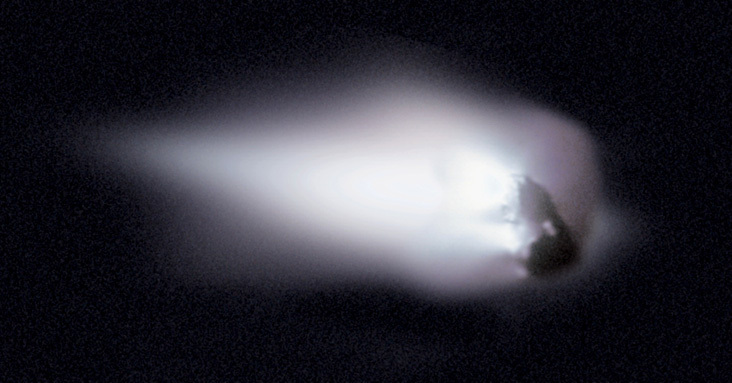
In 1986, the European spacecraft Giotto became one of the get-go spacecraft ever to encounter and photograph the nucleus of a comet, passing and imaging Halley's nucleus as information technology receded from the Sun. Image Credit: Halley Multicolor Photographic camera Team, Giotto Project, ESA
1P/Halley is often called the nearly famous comet considering it marked the kickoff time astronomers understood comets could be repeat visitors to our night skies. Astronomers have now linked the comet's appearances to observations dating back more two,000 years.
Halley was concluding seen in Globe's skies in 1986 and was met in space by an international fleet of spacecraft. Information technology will render in 2061 on its regular 76-year journey around the Sun.
The History of Halley's Comet
Until the time of English astronomer Edmond Halley (1656-1742), comets were believed to make only one laissez passer through the solar organization.
Merely in 1705, Halley used Isaac Newton's theories of gravitation and planetary motions to compute the orbits of several comets. Halley found the similarities in the orbits of bright comets reported in 1531, 1607 and 1682 and he suggested that the trio were really a single comet making return trips. Halley correctly predicted the comet'south render in 1758-1759 — 16 years after his death — and history'south outset known "periodic" comet was after named in his award.
The comet has since been connected to aboriginal observations going back more than ii,000 years. It is featured in the famous Bayeux tapestry, which chronicles the Battle of Hastings in 1066.
In 1986, an international fleet spacecraft met the comet for an unprecedented study from a variety of vantage points. The science fleet included Japan'south Suisei and Sakigake spacecraft, the Soviet Union'southward Vega 1 and Vega 2 (repurposed after a successful Venus mission), the international ISEE-3 (ICE) spacecraft and the European Space Bureau'south Giotto. NASA'southward Pioneer vii and Pioneer 12 also contributed the the bounty of science information collected.
Halley's Connection to Meteor Showers
Each time Halley returns to the inner solar system its nucleus sprays water ice and rock into space. This debris stream results in two weak meteor showers each twelvemonth: the Eta Aquarids in May and the Orionids in Oct.
Size
Halley'south dimensions are about 9.3 past v miles (15 kilometers by 8 kilometers). It is 1 of the darkest, or to the lowest degree reflective, objects in the solar system. It has an albedo of 0.03, which ways that it reflects only three% of the light that falls on information technology.
Orbit
Comet Halley moves astern (contrary to Globe'south motion) effectually the Dominicus in a plane tilted 18 degrees to that of the Earth's orbit. Halley'southward backward, or retrograde, motion is unusual amongst short-period comets, as is its greatest altitude from the Lord's day (aphelion) is beyond the orbit of Neptune.
Halley'south orbit period is, on average, 76 Earth years. This corresponds to an orbital circumference effectually the Sun of nigh 7.6 billion miles (12.2 billion kilometers). The period varies from appearance to appearance considering of the gravitational effects of the planets. Measured from one perihelion passage to the adjacent, Halley's period has been as short equally 74.42 years (1835-1910) and equally long as 79.25 years (451-530).
The comet'south closest arroyo to Earth occurred in 837, at a distance of 0.033 AU (3.07 million miles or 4.94 meg kilometers). At that fourth dimension, April x, 837, Halley reached a total apparent brightness of most magnitude -3.5, almost that of Venus at greatest brilliance. The calorie-free of Halley was spread over an extended area, however, so its surface effulgence was less than that of Venus.
During its 1986 appearance, Halley's nearest approach to Earth occured on the outbound leg of the trip at a distance of 0.42 AU (39 one thousand thousand miles or 63 million kilometers). It was slightly brighter than the north star Polaris, but over again spread over a much larger surface area than a point-like star.
At aphelion in 1948, Halley was 35.25 AU (3.28 billion miles or v.27 billion kilometers) from the Sun, well beyond the distance of Neptune. The comet was moving 0.91 kilometers per second (2,000 mph). At perihelion on February 9, 1986, Halley was just 0.5871 AU (87.8 million km: 54.6 one thousand thousand miles) from the Sun, well inside the orbit of Venus. Halley was moving at 122,000 mph (54.55 kilometers per 2nd).
Lifetime
With each orbit effectually the Sun, a comet the size of Halley loses an estimated three to 10 anxiety (i to 3 meters) of fabric from the surface of its nucleus. Thus, as a comet ages, information technology eventually dims in appearance and may lose all the ices in its nucleus. The tails disappear at that phase, and the comet finally evolves into a night mass of rocky material or mayhap dissipates into dust.
Scientists calculate that an average periodic comet lives to complete near 1,000 trips effectually the Sun. Halley has been in its present orbit for at least xvi,000 years, just it has shown no obvious signs of aging in its recorded appearances.
How Comet 1P/Halley Got Its Name
Comets are usually named for their discoverer(southward) or for the name of the observatory/telescope used in the discovery. Since Halley correctly predicted the render of this comet — the commencement such prediction — it is named for him to honour him. The letter "P" indicates that Halley is a "periodic" comet. Periodic comets accept an orbital period of less than 200 years.
Source: https://solarsystem.nasa.gov/asteroids-comets-and-meteors/comets/1p-halley/in-depth/
0 Response to "Hailey Comet Coming Near Earth Again"
Post a Comment